

🛡️ Template #21376: Payment Webhook Sanitizer & Security Audit Pipeline
Published on n8n.io Creator PortalTemplate ID: 21376
🔗 Direct n8n Template Link:
n8n.io/workflows/21376
🎯 Overview & Use Cases
In modern production payment gateways (Stripe, Razorpay, Lemon Squeezy, Shopify, PayPal), incoming webhook events carry mission-critical financial data. However, engineering teams face significant architectural challenges:
- Unformatted & Minified Payloads: Gateways often stream compact, escaped, or minified JSON strings that risk malformed parsing errors and crash downstream database ingest pipelines.
- Replay & Tampering Vulnerabilities: Financial and order transactions require deterministic cryptographic SHA-256 integrity digests to guarantee non-repudiation and verify payload authenticity.
- Traceability Gaps Across Systems: Without unified identifiers, debugging failed payment events across PostgreSQL, Slack alerts, and application logs is slow and fragmented.
Template #21376 acts as an in-memory security and audit gateway. It intercepts incoming webhook payloads, validates and formats JSON, generates cryptographic checksums and UUID v4 correlation tokens, normalizes order slugs, and routes verified audit records to Slack and downstream databases—running 100% in local memory with zero external cloud API latency.
📸 Workflow Architecture
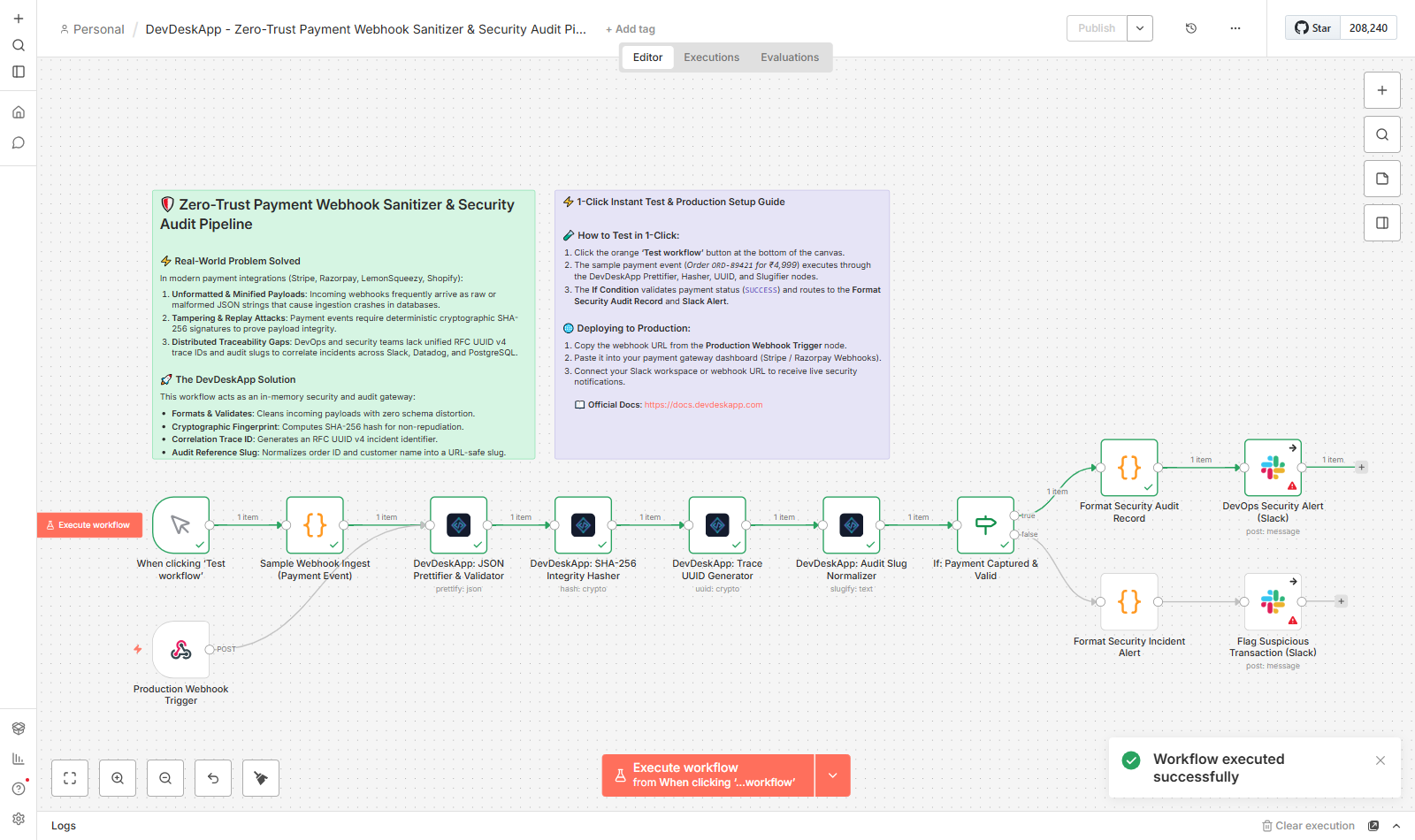
Figure 1: Complete security audit and webhook sanitization canvas in n8n.
🧩 Interactive Architecture & Multi-Stage Execution Flow
mermaid
flowchart TD
    subgraph Ingestion ["📥 Stage 1: Ingestion Gateway"]
        T1["⚡ 1-Click Manual Trigger (Testing)"]
        T2["🌐 Production Webhook Trigger (Stripe / Razorpay)"]
        Payload["📦 Inbound Webhook Payload (Headers + Raw Body)"]
        T1 --> Payload
        T2 --> Payload
    end

    subgraph CoreEngine ["🛡️ Stage 2: DevDeskApp In-Memory Processing Engine (<0.2ms)"]
        direction TB
        N1["1️⃣ JSON Prettifier & Schema Validator
Unescapes raw JSON strings and formats cleanly"]
        N2["2️⃣ SHA-256 Non-Repudiation Hasher
Computes timing-safe cryptographic payload checksum"]
        N3["3️⃣ RFC UUID v4 Incident Generator
Injects distributed trace correlation token"]
        N4["4️⃣ Audit Reference Slugifier
Creates URL-safe audit identifier (order + customer)"]
        N1 --> N2 --> N3 --> N4
    end

    subgraph Decision ["⚖️ Stage 3: Security Validation & Condition Check"]
        Check{"Payment Status == SUCCESS
& Payload Valid?"}
    end

    subgraph VerifiedPath ["✅ Stage 4A: Authenticated Dispatch Pipeline"]
        SuccessAudit["📄 Format Security Audit Record
Normalized JSON for PostgreSQL / Supabase Log"]
        SlackSuccess["💬 DevOps Slack Alert
#devops-security-alerts (Verified Transaction)"]
        SuccessAudit --> SlackSuccess
    end

    subgraph IncidentPath ["🚨 Stage 4B: Security Incident & Tamper Pipeline"]
        IncidentAudit["⚠️ Format Security Incident Record
Flags failed payment, tampered payload, or schema error"]
        SlackIncident["🚨 Tamper Slack Alert
#security-tamper-alerts (Action Required)"]
        IncidentAudit --> SlackIncident
    end

    Payload --> N1
    N4 --> Check
    Check -- "Verified (SUCCESS)" --> SuccessAudit
    Check -- "Rejected / Tampered" --> IncidentAudit
🔍 Execution Walkthrough (Step-by-Step):
- Stage 1 (Dual Ingest): Supports instant 1-click test runs via manual trigger or live production webhooks from payment gateways with zero configuration changes.
- Stage 2 (Local In-Memory Security): In sub-millisecond local Node.js cycles, DevDeskApp prettifies the payload, computes a SHA-256 cryptographic digest, assigns an RFC 4122 UUID v4 trace ID, and generates a unified audit slug.
- Stage 3 (Zero-Trust Condition): The
Ifnode evaluates payment capture status and integrity verification. - Stage 4 (Multi-Channel Routing):
- Success Route: Emits a compliant audit record and notifies
#devops-security-alerts. - Incident Route: Catches tampered or failed transactions and triggers an immediate escalation to
#security-tamper-alerts.
- Success Route: Emits a compliant audit record and notifies
⚙️ Core Operations in Pipeline
| Node / Step | Tool / Operation | Purpose |
|---|---|---|
| 1. Webhook Ingest | manualTrigger / webhook | Ingests live payment event headers and raw JSON body |
| 2. JSON Prettifier | devDeskApp → prettify | Normalizes and validates raw/minified payload into structured JSON |
| 3. Integrity Hasher | devDeskApp → hash (SHA-256) | Computes timing-safe SHA-256 cryptographic digest of payload |
| 4. Trace Token | devDeskApp → uuid (v4) | Injects RFC 4122 UUID v4 incident identifier for distributed audit tracing |
| 5. Audit Slugifier | devDeskApp → slugify | Generates clean URL-safe tracking slug from customer name and order ID |
| 6. Security Dispatch | code + slack | Emits structured compliance payload and triggers real-time security alerts |
⚡ Consolidated Audit Output Sample
When executed, the workflow produces a structured, tamper-proof security record:
json
{
  "auditRecord": {
    "traceId": "c47a2846-95e2-4bd1-bc91-236b3f7f02ea",
    "eventChecksum": "a79c4a8b753f19e782e4e135d0e729a4a753697e8838ec6f4bf4b74e64903e1a",
    "auditSlug": "priya-patel-ord-89421",
    "gatewayEvent": "payment.captured",
    "paymentId": "pay_N982kls823a",
    "orderId": "ORD-89421",
    "customer": {
      "name": "Priya Patel",
      "email": "[email protected]",
      "tier": "enterprise"
    },
    "amountFormatted": "₹4,999.00",
    "currency": "INR",
    "paymentMethod": "UPI",
    "status": "VERIFIED_SUCCESS",
    "processedAt": "2026-10-23T19:40:00.000Z"
  }
}
📥 How to Import into Your n8n Instance
- Open the official template page on n8n.io.
- Click "Use workflow" or copy the workflow JSON payload.
- In your n8n workspace, navigate to Workflows → New Workflow.
- Press
Ctrl + V(orCmd + Von Mac). - Configure the Production Webhook Trigger URL in your payment gateway dashboard (Stripe / Razorpay webhooks) and connect your Slack alerts channel!